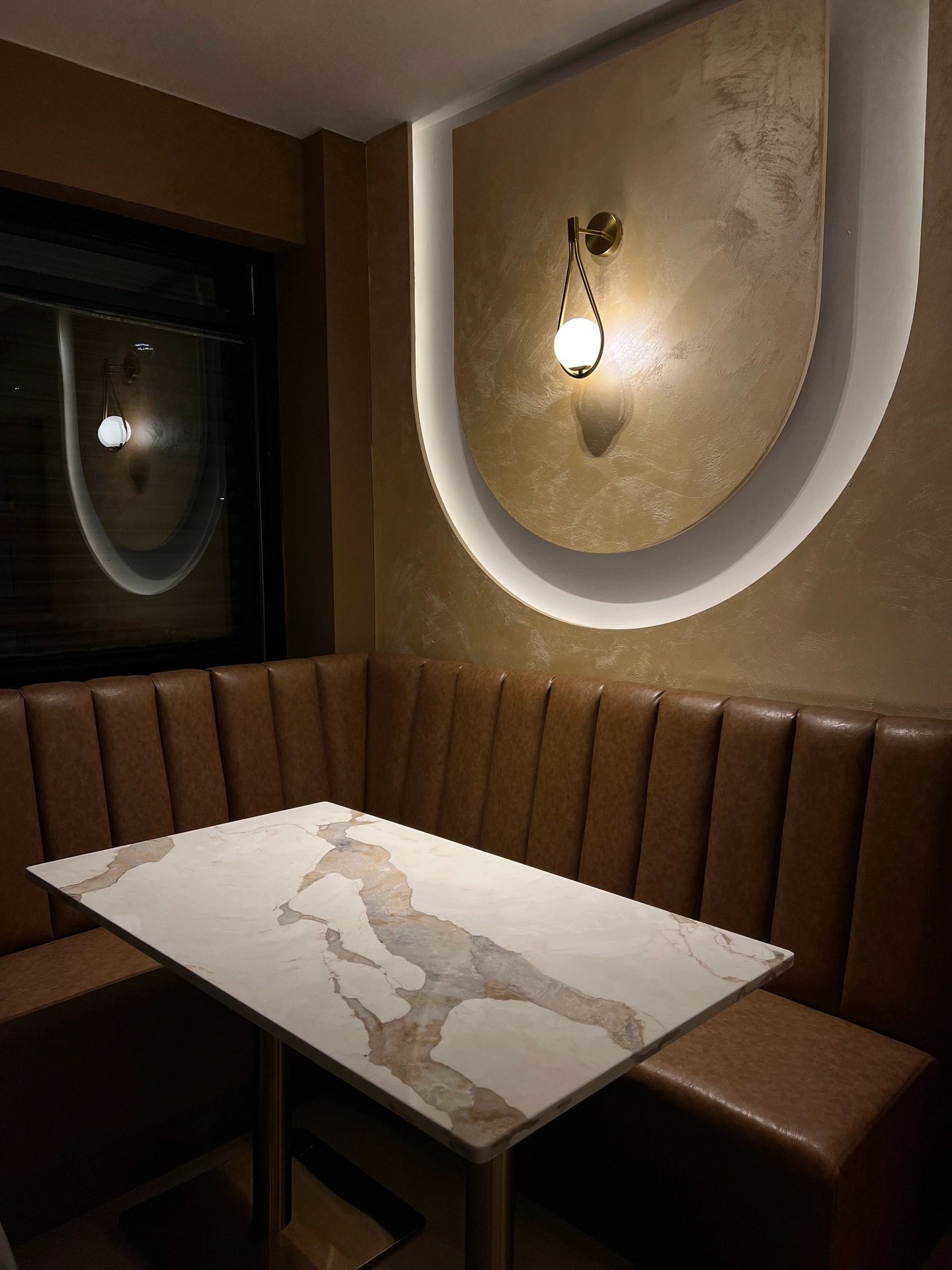
Polished plaster
Polished plaster is a family of trowelled finishes made from slaked lime and marble dust, applied in thin coats and burnished with a steel trowel until the surface takes a sheen. The coarser grades, often sold as Marmorino, leave a stone-like texture with a soft sheen; the finest grades, the Venetian finishes, are polished until they read as marble. As the lime cures it carbonates and turns back into a form of limestone, which is why a well-made polished plaster wall is hard, breathable and repairable.
What it asks of the room is a flat, sound, dry substrate, because every undulation shows once the light rakes across it; time between coats; and a decision about light early, since concealed LED in a recess or a wash from a wall light is what brings the depth out. In the dining room at Kashmiri Karahi the walls are polished plaster, with three arched recesses picked out in concealed LED and a brass wall light inside each. A sealer, wax or resin, is specified where the wall will be touched, splashed or wiped.
Fluted panelling
Fluted panelling is a run of half-round or square-edged ribs, in timber, veneered MDF or a painted composite, fixed vertically to the wall. It gives a flat wall depth, hides the joints in a long run, and takes paint, stain or veneer. It is fitted to a batten frame or bonded to a true substrate, and the module of the flute, its width and its spacing, is set out on the drawing so that the ribs finish cleanly at corners, at sockets and at the end of the run rather than being cut short.
The panelling decides where services can go: sockets, switches and lights are positioned in the drawing so that they land on a flat between flutes or on a purpose-made plate. At Qabaña the walls are fluted panelling in deep green, floor to ceiling, with the wordmark and a neon artwork mounted on it and the light coming from under the banquette below.
Brass
Brass appears in a room as trims, edges, fittings and furniture: the strip that caps a run of tile at dado height, the profile where a floor meets a plinth, wall lights and pendants, tap and shower fittings, table bases. The decision is between solid brass, which patinates and can be refinished, and a brass finish on another metal: plated brass, which should be lacquered, or a PVD coating on stainless steel, which holds its colour under daily use.
What brass asks of the room is a line to follow. A trim looks intentional when it runs continuously, at the same height, around the whole room, so its height is set on the elevation drawings and the tile module is chosen to meet it. At Blue Emerald the blue stone-effect tile stops at dado height on a brass trim, and the same brass line runs along the floor where the plinth meets the boards; the bath filler and the wall-hung basin tap are brass to match.
What to settle on the drawings
- The substrate: which walls are replastered flat before a finish goes on, and which are battened out.
- The setting-out: the flute module, the tile module, the trim height, so the finishes meet each other cleanly.
- The light: where the concealed LED, the wall lights and the pendants sit, because each finish is chosen for how it looks lit.
- The services: every socket, switch and fitting positioned against the finish, not after it.
- The samples: a polished plaster sample board, a fluted panel section and the brass finish, side by side on the materials board before anything is ordered.
Those decisions are made at the drawing stage of the studio's process, so that the finishes are priced line by line rather than allowed for. The rooms where they have been fitted are on the restaurant fit-outs page and in the portfolio.
Sources
- Stucco Italiano: Marmorino mineral wall plaster
- Vasari: Marmorino and Venetian plaster, the differences
Rules and figures checked in September 2026 and given for England unless stated. They change; check the current wording with the local authority before relying on them.